What Is a Supply Chain Attack?
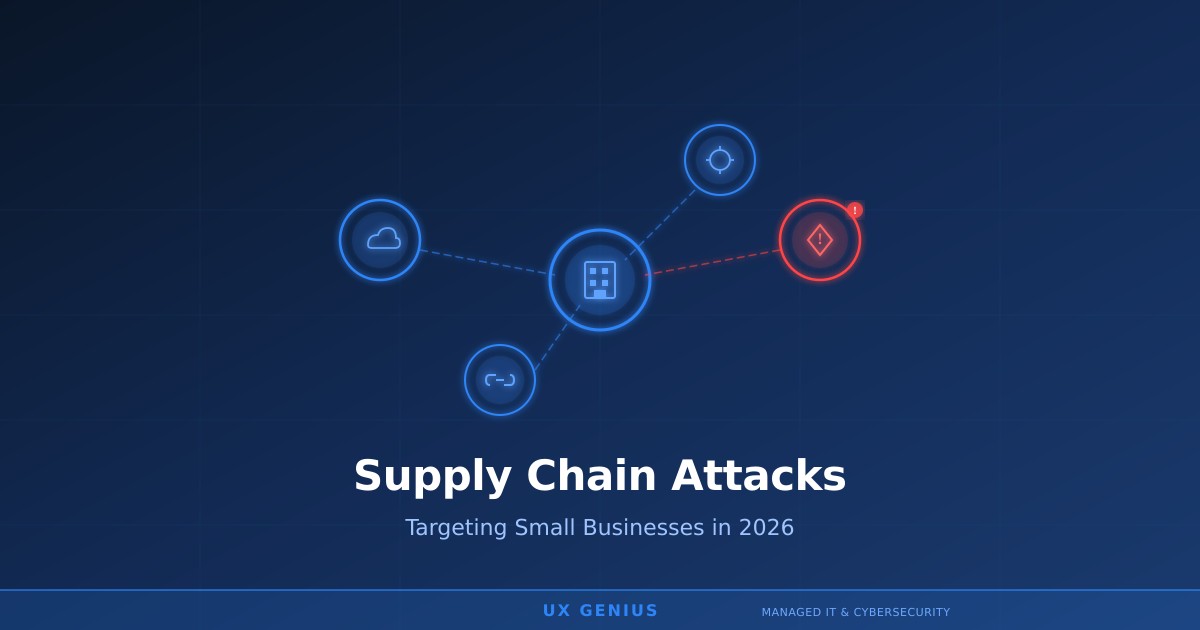
A supply chain attack doesn't target your business directly. Instead, it targets someone you trust — a software vendor, a cloud provider, a managed service platform, or even a billing partner. The attacker compromises that trusted third party, then uses the established relationship to slip into your network unnoticed.
Think of it this way: instead of picking the lock on your front door, the attacker steals the keys from your housekeeper. You let them in because you trust the person holding the keys.
In 2025, supply chain attacks increased by over 200% compared to the previous year, and small businesses bore the brunt. According to industry reports, organizations with fewer than 500 employees accounted for more than 60% of all supply chain breach victims. The reason is straightforward: small businesses have fewer resources for vendor security assessments, less mature patch management, and often rely heavily on third-party tools without verifying their security posture.
Why Small Businesses Are the Primary Target
Enterprise organizations have invested heavily in supply chain risk management since the SolarWinds breach of 2020. They vet vendors, require SOC 2 compliance, and monitor third-party access. Small businesses rarely do any of this — and attackers know it.
Here's why small businesses are especially vulnerable:
- Trusted access is already granted. Your accounting software, CRM plugins, IT management tools, and cloud backups all have privileged access to your network. An attacker compromising any one of these gains a foothold without needing to breach your perimeter.
- Vendor sprawl without oversight. The average small business uses 40-80 SaaS applications. Each one is a potential attack vector. Most small businesses have no inventory of these tools, let alone a security review process.
- Limited detection capabilities. Without 24/7 monitoring or SIEM tools, a supply chain attack can persist for months before anyone notices. The average dwell time for small business breaches is 200+ days.
- Downstream value to attackers. Your business may be small, but you likely connect to larger partners, clients, or suppliers. Attackers use you as a stepping stone to reach bigger targets.
Real Attack Vectors Hitting Small Businesses in 2026
The supply chain threat landscape has shifted significantly. Here are the most common attack vectors we're seeing in 2026:
Compromised Software Updates
The classic supply chain technique: attackers compromise a software vendor's build or update system, inject malicious code into a legitimate update, and distribute it to every customer who clicks "update." The Kaseya VSA attack in 2021 affected over 1,500 businesses — many of them small MSPs and their clients. In 2026, we're seeing this technique applied to smaller, niche software tools that small businesses rely on, from accounting plugins to HR platforms.
Malicious NPM and PyPI Packages
Open-source supply chain attacks have exploded. Attackers create packages with names similar to popular libraries (typosquatting), or compromise maintainer accounts to inject malicious code into legitimate packages. If your website, app, or internal tools pull from these repositories without proper verification, you're exposed. In 2025, over 200,000 malicious packages were detected across major registries.
Breached Managed Service Providers
MSPs manage IT for dozens or hundreds of small businesses. A single MSP compromise can cascade across every client they serve. Attackers actively target MSPs because one breach yields hundreds of downstream victims. If your MSP doesn't practice strong security hygiene — MFA, network segmentation, endpoint detection — they become your weakest link.
Compromised SaaS Integrations
OAuth tokens and API keys granted to third-party SaaS tools are gold for attackers. A compromised CRM plugin with read/write access to your email, files, and contacts gives an attacker everything they need for business email compromise, data theft, or lateral movement into your network.
The Hidden Costs of a Supply Chain Breach
The average cost of a supply chain breach for a small business in 2025 was $165,000 — and that's just the direct costs. The full impact is much larger:
| Impact Area | Typical Cost | Recovery Time |
|---|---|---|
| Incident response and forensic investigation | $25,000 - $75,000 | 2-4 weeks |
| Business downtime and lost revenue | $10,000 - $50,000/day | 1-3 weeks |
| Regulatory fines and legal fees | $15,000 - $100,000+ | 3-12 months |
| Customer notification and credit monitoring | $5,000 - $30,000 | Ongoing |
| Reputation damage and customer churn | $50,000 - $500,000+ | 6-24 months |
For a small business generating $1-5M in annual revenue, a single supply chain breach can be existential. 60% of small businesses that suffer a cyberattack go out of business within six months.
How to Protect Your Business from Supply Chain Attacks
You can't eliminate supply chain risk entirely — every business relies on third-party tools. But you can dramatically reduce your exposure with these controls:
Vendor Security Assessments
Before granting any vendor access to your systems, require them to complete a security questionnaire. Ask about their MFA policies, encryption practices, incident response plans, and third-party audits. If they can't provide a SOC 2 report or equivalent, that's a red flag.
Least-Privilege Access for Integrations
Every SaaS integration should have the minimum permissions necessary to function. A marketing analytics tool does not need full access to your email account. A billing plugin does not need write access to your file storage. Audit OAuth grants and API scopes quarterly — revoke anything that's overprivileged or unused.
Network Segmentation
Isolate third-party tools and vendor access into segmented network zones. If a vendor's tool is compromised, segmentation prevents the attacker from moving laterally into your core business systems. This is one of the most effective defenses against supply chain attacks.
Patch Management and Continuous Monitoring
Apply security patches within 48 hours of release — especially for tools with privileged network access. Deploy endpoint detection and response (EDR) on every device, and maintain 24/7 log monitoring to detect anomalous behavior from compromised vendors before it escalates.
Zero Trust Architecture
Adopt a "never trust, always verify" mindset. Zero Trust means every access request — whether from inside your network or a trusted vendor — is authenticated, authorized, and encrypted before access is granted. This limits the blast radius of any single compromise.
Building a Supply Chain Security Plan
If you don't have a supply chain security plan, you're not alone — most small businesses don't. Here's a practical starting point:
- Inventory your vendors. List every third-party tool, integration, and service with access to your data or network. Most businesses discover they have 3-4x more than they thought.
- Rank by risk. Prioritize vendors with privileged access, direct network connections, or access to sensitive data (financial, healthcare, customer PII).
- Verify security posture. Request SOC 2 reports, security questionnaires, or at minimum, written confirmation of MFA, encryption, and incident response procedures from your top 10 vendors.
- Reduce attack surface. Remove unused integrations, revoke overprivileged OAuth grants, and consolidate redundant tools.
- Monitor continuously. Set up alerts for vendor security advisories, monitor network traffic for anomalies, and review access logs weekly.
- Create an incident response plan. Document exactly what to do if a vendor is compromised — who to call, which systems to isolate, and how to communicate with stakeholders.
How UX Genius Helps Protect Your Business
As an IT managed service provider serving businesses across Northern Virginia, Washington D.C., and Maryland, UX Genius builds supply chain security into every engagement. We don't just react to threats — we architect your environment to minimize risk from the start.
Our approach includes:
- Vendor risk assessments — We evaluate every tool and integration in your stack for security posture and overprivileged access
- Network segmentation — We design and implement segmented networks that contain breaches before they spread
- Patch management — 48-hour patch SLA for critical vulnerabilities across all managed endpoints
- 24/7 monitoring and EDR — Continuous threat detection with real-time alerting and automated response
- Zero Trust implementation — We deploy identity-first security architectures that verify every access request
- Incident response — Documented playbooks and rapid response when a vendor or supply chain compromise is detected
Supply chain attacks exploit trust — the trust you place in vendors, tools, and partners. The best defense isn't more firewalls. It's reducing that trust to the minimum necessary and verifying everything else.
If your business relies on third-party tools — and every business does — you need a partner who understands supply chain risk and knows how to mitigate it. Learn more about our managed IT services or schedule a free IT assessment to find out where your supply chain exposures are and how to close them.